
The Story Behind the World’s Most Revolutionary Technology
“The machines are coming.”
For decades, those words lived only in the realm of imagination.
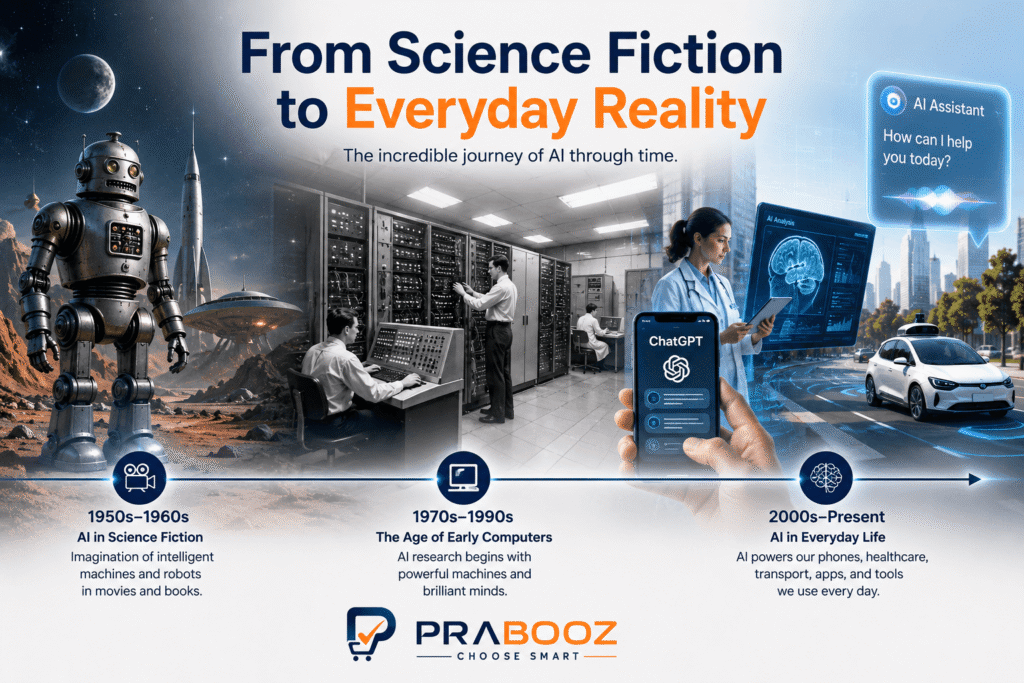
Cinema screens glowed with visions of robot-filled cities. Novelists painted worlds where computers outsmarted their creators. Audiences watched machines talk, think, and even dream — leaving theatres convinced such futures were centuries away.
But reality had a quieter script.
Artificial Intelligence didn’t storm into our lives with towering robots or dramatic headlines. It slipped in almost unnoticed, one small innovation at a time.
It learned to recommend the next song you might love. It suggested a faster route when traffic clogged your way home. It recognised your face before unlocking your phone. It filtered spam from your inbox, translated languages in seconds, and answered questions that once demanded hours of searching.
Most people never realised when AI became part of their daily routine. And perhaps that is its greatest triumph.
The technologies that truly reshape civilisation rarely announce themselves. Electricity didn’t ask permission before lighting the world. The internet didn’t wait for everyone to understand it before connecting billions. Artificial Intelligence followed the same path — weaving itself so deeply into everyday life that we use it dozens of times a day without even noticing.
Today, AI helps doctors detect diseases earlier than ever. Farmers monitor crops with precision. Students learn with personalised tutors. Businesses make smarter decisions. Scientists search for new medicines. Artists create breathtaking images from a single sentence. Writers find inspiration, programmers build faster, and families solve everyday problems with digital assistants.
What once seemed like science fiction has quietly become reality.
And yet, despite its growing influence, AI remains one of the most misunderstood technologies of our time.
For some, it is a miracle destined to solve humanity’s greatest challenges. For others, it is a mysterious force threatening jobs, privacy, and even civilisation itself.
Both views carry fragments of truth. Neither tells the whole story.
To understand Artificial Intelligence, we must set aside both excitement and fear. What remains is curiosity — the same curiosity that drove generations of scientists, mathematicians, engineers, and dreamers to ask one extraordinary question:
Can a machine learn?
That question has shaped more than seventy years of research, countless failures, remarkable breakthroughs, and one of the fastest technological revolutions in history.
But before we explore how machines learned to recognise faces, understand language, or create art, we need to travel back to the beginning.
Because the story of Artificial Intelligence did not begin with ChatGPT. It did not begin with smartphones. It did not even begin with computers.
Like many great discoveries, it began with an idea.
A Dream That Refused to Die
Long before the first electronic computer was built, humans imagined creating something extraordinary — an artificial mind.
Ancient myths spoke of mechanical beings that could move and think. Centuries later, inventors built intricate machines that imitated human actions. They could never truly think, but they revealed something timeless: humanity has always been captivated by the possibility of creating intelligence outside itself.
As science advanced, that dream shifted from mythology into mathematics.
By the mid‑20th century, computers were performing calculations at astonishing speeds. They processed numbers faster than any human, yet remained obedient machines. Every instruction had to be written by a programmer. Every decision followed fixed rules. Every mistake traced back to a missing command.
To many researchers, that wasn’t enough.
One man dared to imagine something far more ambitious.
His name was Alan Turing.
In 1950, Turing asked a question that seemed outrageous for its time: “Can machines think?”
Rather than debating philosophy, he proposed a practical test. If a machine could hold a conversation so naturally that a person could not distinguish it from a human, perhaps intelligence should be judged by behaviour rather than biology.
The idea became famous as the Turing Test. The world has debated it ever since, but one truth is undeniable: it changed the direction of computer science forever.
Only a few years later, in the summer of 1956, a small group of researchers gathered at Dartmouth College in the United States. Their meeting lasted only weeks, but its impact continues to shape the modern world.
For the first time, the phrase “Artificial Intelligence” was officially used to describe a field devoted to creating machines capable of performing tasks that normally require human intelligence.
Few outside that room realised history was being written.
From Great Expectations to Long Winters
The pioneers of AI were remarkably optimistic.
Some believed intelligent machines would become reality within a generation.
Instead, reality proved far more demanding.
Computers of the 1950s and 1960s had only a fraction of the power inside today’s smartphones. Memory was scarce. Processing speed was painfully slow. Most importantly, the oceans of digital information needed to teach intelligent systems simply did not exist.
Progress stalled. Funding disappeared. Public excitement faded.
Researchers entered difficult periods later known as the AI Winters, when many believed the dream of intelligent machines had reached a dead end.
Yet beneath that silence, the work never truly stopped.
Across universities and laboratories, scientists refined algorithms, improved mathematical models, and quietly prepared for a future they believed would eventually arrive.
They were planting seeds whose harvest would not be seen for decades.
The Turning Point Nobody Expected
Then something extraordinary happened.
The world became digital.
Suddenly, billions of people were using computers, smartphones, cameras, and the internet every day. Every email, every photograph, every online purchase, every search query, every GPS journey, every social media interaction created information on a scale humanity had never witnessed before.
For Artificial Intelligence, this was more than progress.
It was the missing ingredient.
Powerful computers finally met enormous amounts of data.
The dream that had survived decades of disappointment suddenly found the opportunity it had been waiting for.
Machines began recognising voices with remarkable accuracy. They learned to identify faces in photographs. They translated languages in real time. They defeated world champions in complex games.
Then, almost unexpectedly, they began writing, drawing, composing music, answering questions, and helping millions of people solve everyday problems.
Artificial Intelligence had crossed an invisible threshold.
It was no longer a laboratory experiment. It had become part of everyday life.
And that raises perhaps the most important question of all.
If machines can now perform tasks once thought uniquely human, what exactly is Artificial Intelligence?
More importantly…
How does it actually learn?
That answer takes us to the heart of one of the greatest technological stories ever told.
When Machines Began to Learn
History has always been shaped by inventions that quietly rewrote the rules of civilisation.
The wheel changed how people travelled. The printing press changed how knowledge spread. Electricity changed how societies lived.
Artificial Intelligence belongs in that same conversation — not because machines suddenly woke up one morning with human‑like intelligence, but because of a subtler, more profound breakthrough.
The moment computers stopped waiting for instructions… and began learning from experience.
That single idea changed everything.
Learning Without Being Told Everything
For most of the twentieth century, computers behaved exactly as expected. They followed instructions with perfect discipline. Every calculation, every decision, every action depended entirely on the rules written by a programmer.
They never questioned those rules. They never improved them. And they certainly never learned from yesterday’s mistakes.
Imagine asking an old computer to recognise the face of your best friend.
For a human, recognition is effortless. Even after years apart, even under dim light, even with glasses or a new hairstyle, the brain compares thousands of tiny details without conscious effort.
A computer couldn’t do that. It didn’t understand faces. It only understood instructions. Unless someone described every possible eye shape, nose, smile, angle, shadow, and expression, the machine remained helpless.
Researchers soon realised an uncomfortable truth: the real world contained too many possibilities. No programmer could ever write enough rules to prepare a computer for everything life might present.
So they asked a different question.
Instead of teaching computers every answer… What if computers could learn the answers themselves?
That question opened the door to one of the greatest revolutions in modern science.
The World Through a Child’s Eyes
Watch a small child seeing a butterfly for the first time.
At first, every flying insect looks the same — butterflies, bees, dragonflies, even colourful leaves dancing in the wind.
Then something remarkable happens.
The child keeps watching. Keeps asking questions. Keeps making mistakes.
Little by little, the brain notices differences: the shape of the wings, the colours, the way each insect moves. Weeks later, recognition becomes natural.
Nobody explained millions of rules. Experience became the teacher.
Artificial Intelligence learns in a surprisingly similar way.
No machine is born intelligent. On its first day, an AI system knows nothing about traffic, languages, music, medical images, or human conversations. Its education begins only after it starts observing the world.
Every photograph becomes a lesson. Every spoken sentence becomes another example. Every successful prediction becomes experience. Every mistake becomes another opportunity to improve.
Slowly, patterns emerge. Not because someone programmed them… but because the machine discovered them for itself.
That ability to recognise patterns is the true heart of Artificial Intelligence.
It is also why AI often appears more intelligent than it really is. What looks like understanding is often the result of analysing millions — even billions — of examples with astonishing speed.
The World Became AI’s Classroom
There was another reason Artificial Intelligence accelerated so dramatically in the last decade.
The world itself became its classroom.
Every second, humanity creates an astonishing amount of information.
- People upload photographs.
- Hospitals produce medical scans.
- Cars generate navigation data.
- Banks process financial transactions.
- Weather satellites observe the atmosphere.
- Factories monitor thousands of sensors.
- Businesses record customer behaviour.
- Scientists publish research.
Individually, each piece of information tells a tiny story. Together, they become something extraordinary: experience.
And experience is exactly what Artificial Intelligence needs to learn.
Unlike people, AI never grows tired of studying. It doesn’t complain after reading its millionth document. It doesn’t lose concentration while examining another thousand medical images. Its patience is almost limitless.
Give it enough examples, enough computing power, and enough time, and the machine gradually becomes better at recognising patterns humans themselves may never notice.
That is why today’s AI can detect the earliest signs of disease, predict equipment failures before they occur, recognise speech across accents, or recommend exactly the product someone was hoping to find.
It isn’t magic. It isn’t intuition. It is experience measured at digital speed.
The Quiet Revolution Called Machine Learning
Long before the world started talking about ChatGPT, another revolution had already transformed Artificial Intelligence.
Researchers called it Machine Learning.
The name sounds complex. The idea is beautifully simple.
Instead of programming every instruction… teach the computer how to learn.
That small shift changed decades of computer science.
Streaming platforms stopped recommending films through rigid categories and began understanding what each viewer genuinely enjoyed. Banks became better at spotting suspicious transactions. Search engines started grasping what people actually meant instead of simply matching words. Hospitals discovered new ways to assist doctors during diagnosis. Online shopping became more personal. Navigation apps became more accurate.
Machine Learning wasn’t one invention. It quietly became the invisible engine powering thousands of technologies people already used every day.
Most people never noticed. They simply assumed technology had become smarter. In reality, technology had become better at learning.
Then Came the Biggest Leap of All
Even Machine Learning had limits.
Some problems remained stubbornly difficult: understanding natural conversations, recognising faces from different angles, interpreting complex medical images, driving through unpredictable city traffic.
These challenges demanded something far more sophisticated.
Researchers began building systems loosely inspired by the way networks of neurons communicate inside the human brain.
This new approach became known as Deep Learning.
The name sounded mysterious. Its impact was undeniable.
Suddenly, computers became dramatically better at recognising speech, understanding language, identifying images, and processing information that had previously seemed impossibly complicated.
Voice assistants became more natural. Medical diagnosis became more accurate. Translation tools improved dramatically. Autonomous driving moved closer to reality.
Artificial Intelligence had learned to see and listen with remarkable precision.
The dream imagined decades earlier was slowly becoming reality
| Era | The Breakthrough | Everyday Example |
|---|---|---|
| Rule-Based Systems | Computers followed fixed instructions. | Calculator, early business software |
| Machine Learning | Computers learned from data. | Netflix recommendations, spam filters |
| Deep Learning | AI recognised speech, images, language. | Face Unlock, Google Translate |
| Generative AI | AI began creating original content. | ChatGPT, AI image generation |
| AI Agents (Emerging) | AI performs complex tasks independently | Intelligent assistants, automated workflows |
When AI Started Creating Instead of Simply Understanding
For decades, Artificial Intelligence observed the world.
Then something remarkable happened.
It started creating.
Instead of merely recognising photographs, it generated entirely new images. Instead of translating text, it began writing articles. Instead of completing sentences, it composed stories, poems, software, music, and business ideas.
The arrival of Generative AI surprised even many experts.
For the first time, ordinary people could sit in front of a computer, type a simple question in everyday language, and receive detailed, thoughtful responses within seconds.
Technology no longer felt like a machine waiting for commands. It felt like a conversation.
That single change introduced millions of people to Artificial Intelligence in a way no previous breakthrough ever had.
AI was no longer hidden behind search engines or recommendation systems. It had become something people could speak with, learn from, and create alongside.
The relationship between humans and machines had quietly entered an entirely new chapter.
And perhaps the most surprising part of that story is this:
While the world was busy debating whether Artificial Intelligence would change the future…
It had already changed the present.
The Day You Already Shared With Artificial Intelligence
Tomorrow morning, when your alarm rings, pause for a moment.
Not to hear the sound. To notice everything that happens afterwards.
Within the first few minutes of your day, you may interact with Artificial Intelligence more times than people did in an entire lifetime only twenty years ago.
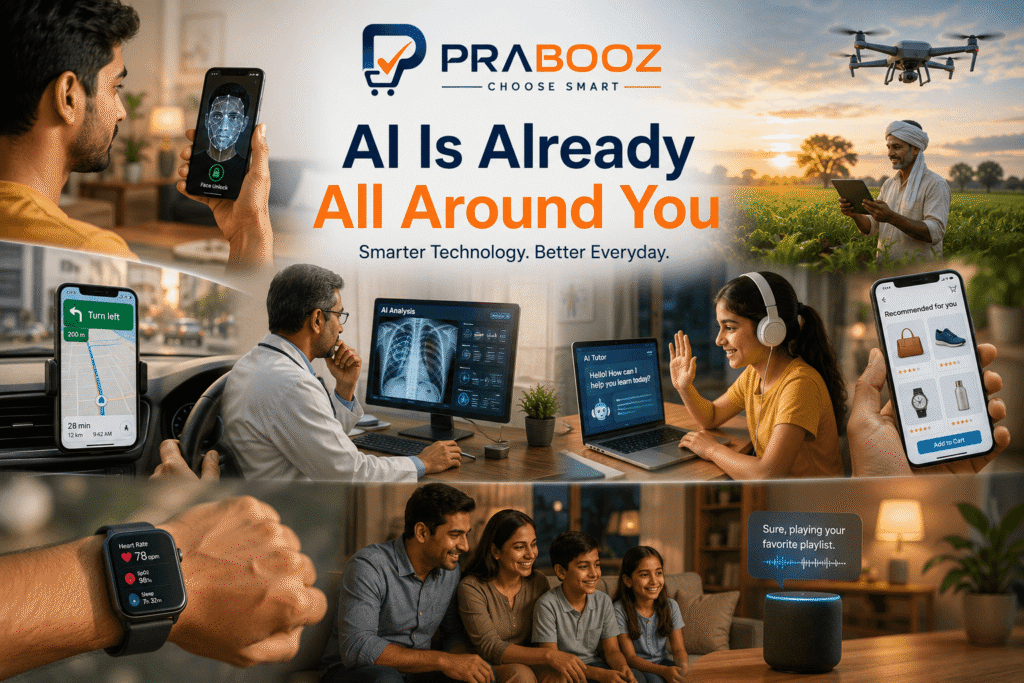
Your phone wakes before you do. A glance is enough for the screen to recognise your face. No passwords. No fingerprints. Just a familiar face meeting a tiny camera.
Outside, dark clouds gather. Before stepping out, you check the weather. That forecast isn’t a lucky guess. Satellites, sensors, radar stations, and intelligent prediction systems have spent the night analysing millions of observations to estimate whether rain will arrive before your evening commute.
You leave for work.
The road you usually take is unusually crowded. Your navigation app quietly suggests another route.
It hasn’t looked at one traffic signal. It has analysed thousands.
Within seconds, it compares road speeds, accidents, construction work, traffic density, and historical travel patterns before deciding there is a faster way to reach your destination.
You simply tap Start. The machine does the thinking.
By the time you arrive at work, Artificial Intelligence has already solved several small problems on your behalf.
You probably never thanked it. Most of us never do.
The Invisible Companion
The most extraordinary technologies rarely demand attention.
Electricity doesn’t remind us every morning that it powers our homes. The internet doesn’t announce itself before every email we send.
Artificial Intelligence is following the same path.
It works quietly. Patiently. Almost invisibly.
Open your inbox. Hundreds of unwanted messages have already been filtered away. Scroll through your music app. It somehow understands the kind of songs you enjoy after only a handful of listens. Browse an online shopping site. Products appear that feel strangely relevant — as though the site already knows what you’ve been searching for.
It doesn’t know you. It knows patterns.
That distinction explains almost everything about modern AI.
It is constantly learning from behaviour, recognising similarities, and making educated predictions about what might be useful next.
Sometimes those predictions are astonishingly accurate. Sometimes they are completely wrong.
But every interaction becomes another lesson. Every click teaches something. Every correction improves the next prediction.
Quietly, continuously, Artificial Intelligence becomes a little more useful than it was yesterday.
The Doctor Who Sees Twice
One afternoon, a radiologist sits before a computer screen examining hundreds of medical images.
Every scan matters. Every decision carries responsibility.
Most abnormalities are obvious. Some are almost invisible — a faint shadow, a subtle irregularity, the kind even experienced specialists might overlook after hours of concentration.
Now imagine another set of eyes examining the same image.
Not human eyes. Digital ones.
An AI system trained on millions of medical scans quietly highlights an area that deserves closer attention.
It doesn’t announce a diagnosis. It doesn’t replace the doctor’s expertise. It simply whispers: “Take another look here.”
Sometimes that second opinion makes all the difference.
Around the world, similar stories unfold every day. AI helps doctors detect diseases earlier, giving patients valuable time that traditional methods might not always provide.
The technology doesn’t replace medical professionals. It strengthens them. Like an experienced colleague who never grows tired.
A Farmer Looking at the Sky — and Beyond
For generations, farmers looked to the sky for signs of rain.
They studied the colour of clouds. The direction of the wind. The rhythm of the seasons.
Experience was their greatest teacher.
Today, farmers still depend on that wisdom. But many now have another partner: Artificial Intelligence.
Drones fly quietly above fields, spotting unhealthy crops before damage spreads. Sensors buried in soil measure moisture levels invisible to the human eye. Weather prediction systems combine satellite imagery with historical climate patterns, helping farmers decide the best time to irrigate, fertilise, or harvest.
Technology hasn’t replaced generations of farming knowledge. It has given that knowledge another source of insight.
The oldest profession in human history has found an unlikely companion in one of the newest technologies ever created.
The Quiet Revolution Inside Every Industry
Walk through almost any modern workplace and you’ll find Artificial Intelligence already at work.
Inside banks, intelligent systems examine thousands of transactions every second, searching for unusual activity that could indicate fraud. In factories, cameras never blink. They inspect products continuously, identifying defects so small they might escape even the sharpest human eye. Teachers use AI‑powered tools to help students progress at their own pace, supporting many learning styles in one classroom. Scientists analyse research papers, study climate models, and search for patterns hidden inside enormous datasets. Architects explore hundreds of design possibilities before drawing the final blueprint. Filmmakers experiment with visual effects that once demanded months of manual work. Writers organise research more efficiently. Software developers discover programming errors before they become costly failures.
Across every profession, the pattern is the same.
Artificial Intelligence isn’t replacing human ambition. It is removing repetitive work so people can spend more time thinking, creating, and solving problems that truly require imagination.
That may ultimately become AI’s greatest contribution — not doing our jobs for us, but allowing us to focus on the parts that make us uniquely human.
Technology Is Changing. So Are We.
Every generation has witnessed a technological revolution.
Our grandparents watched electricity transform homes. Our parents saw computers enter offices. We grew up with the internet connecting the world.
The next generation may simply assume every machine is intelligent.
For them, asking questions to Artificial Intelligence could feel as natural as opening a web browser feels to us today.
That quiet shift tells us something profound.
Artificial Intelligence is no longer a glimpse of tomorrow. It has become part of the rhythm of modern life.
Yet every powerful tool carries responsibility.
The same technology that helps doctors save lives can also create convincing misinformation. The same algorithms that recommend useful products can sometimes reinforce bias. The same systems that improve efficiency can raise difficult questions about privacy, employment, and ethics.
Like every transformative invention before it, Artificial Intelligence brings both extraordinary opportunities and important responsibilities.
Understanding both is what separates informed users from passive observers.
And that is exactly where our journey leads next.
Because before deciding what the future of AI should look like… We must first understand both its greatest strengths and its most important limitations.
The Future Will Not Be Built by Artificial Intelligence Alone
Imagine standing outside a blacksmith’s workshop two centuries ago.
The sound of iron striking iron echoed through the village. Skilled hands shaped tools farmers depended upon, horseshoes travellers trusted, and household items that lasted for generations.
Then came the Industrial Revolution.
Steam engines roared. Factories rose. Machines produced goods faster than any craftsman ever could.
Many believed traditional skills would vanish forever.
They didn’t.
The world simply changed.
People learned new skills. Old professions evolved. Entirely new industries emerged.
History repeated itself when electricity entered homes, when computers arrived in offices, and when the internet connected the world.
Each revolution created uncertainty. Each also created opportunity.
Artificial Intelligence is simply the next chapter in that long human story.
The question has never been whether technology will change our lives. It always has.
The real question is whether we are willing to grow alongside it.
The Strength of Artificial Intelligence
Artificial Intelligence has already proven its extraordinary capabilities.
It can analyse millions of medical records in the time it takes a person to sip a cup of coffee. It can monitor forests from satellites, helping scientists detect wildfires before they spread. It can translate conversations between people who do not share a common language, making communication easier across cultures.
It helps banks identify suspicious financial activity, protects businesses from cyber threats, and enables researchers to process scientific information at speeds unimaginable only a generation ago.
For people living with disabilities, AI-powered tools have opened doors once firmly closed. Speech recognition assists those who cannot type. Vision systems describe surroundings for people with visual impairments. Real-time captions make conversations more accessible for those with hearing loss.
These achievements are not headlines. They are lives quietly improved.
Perhaps that is the true measure of technological progress — not how impressive it appears, but how many people it helps without asking for attention.
The Questions We Cannot Ignore
Yet every powerful invention carries responsibility.
The same intelligence that creates realistic educational videos can also generate convincing misinformation. The same technology that protects people from fraud can become a tool for sophisticated cybercrime. Algorithms trained on incomplete or biased information may unintentionally produce unfair decisions. Personal data collected for convenience raises urgent questions about privacy.
As AI becomes more capable, societies around the world are beginning to ask difficult but necessary questions:
- Who is responsible when an autonomous system makes a mistake?
- How should AI be used in education?
- Where should governments draw legal boundaries?
- How do we ensure technology serves humanity rather than the other way around?
These are no longer questions reserved for scientists. They belong to all of us.
Because Artificial Intelligence is no longer confined to research laboratories. It is becoming part of our homes, our schools, our workplaces, and our communities.
Its future will depend not only on programmers, but also on teachers, doctors, lawmakers, business leaders, parents, and ordinary citizens who decide how this technology should be used.
Why Human Intelligence Still Matters Most
There is one question that appears in almost every conversation about Artificial Intelligence:
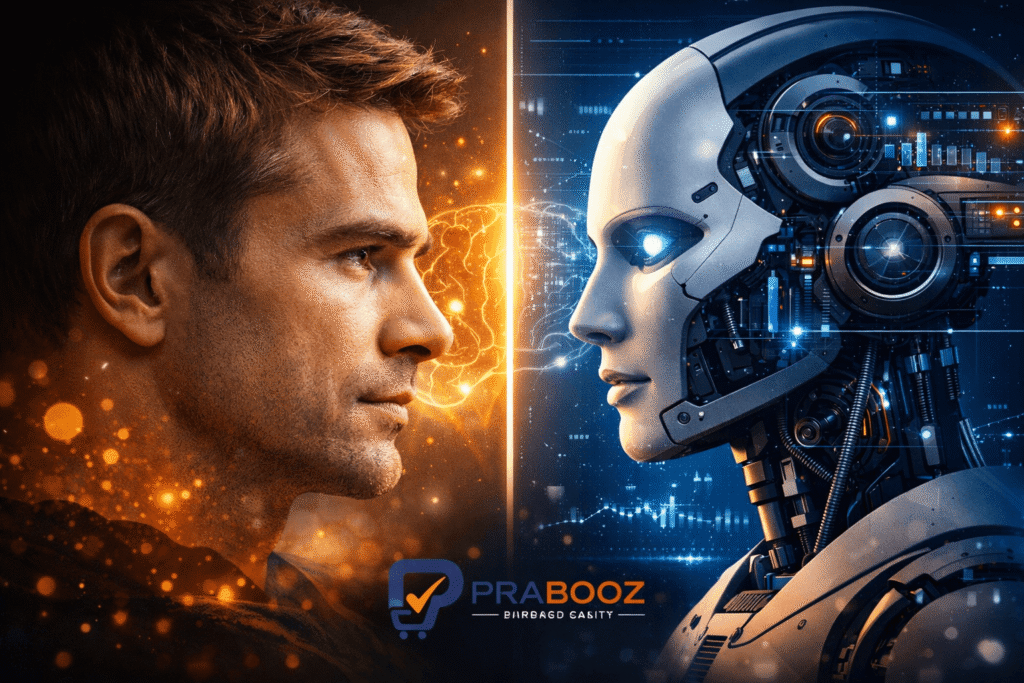
Will AI replace humans?
It is an understandable fear.
History shows that every major technological revolution has changed the way people work.
Some jobs disappeared. Many more evolved. Entirely new careers emerged that previous generations could never have imagined.
Artificial Intelligence will almost certainly follow the same pattern.
Routine and repetitive work will increasingly be handled by intelligent systems.
But the qualities that define humanity remain remarkably difficult to imitate.
A machine can analyse emotion. It cannot truly feel it.
A machine can generate music. It has never experienced heartbreak.
A machine can recommend the most efficient decision. It cannot carry moral responsibility for that decision.
It can calculate. It cannot care.
The future does not belong to humans alone. Nor does it belong to machines.
It belongs to people who know how to combine the speed of Artificial Intelligence with the wisdom, creativity, and compassion that only human beings can bring.
Human Intelligence vs Artificial Intelligence
| Human Intelligence | Artificial Intelligence |
|---|---|
| Learns through life experiences | Learns from data and training |
| Guided by emotions, ethics, and values | Guided by algorithms and mathematical models |
| Thinks creatively in unfamiliar situations | Excels at recognising patterns in known data |
| Exercises judgment and empathy | Processes information with extraordinary speed |
| Takes responsibility for decisions | Assists decision-making but has no moral responsibility |
Rather than competitors, human intelligence and Artificial Intelligence are best understood as two very different forms of capability — each strong where the other is limited.
The Next Chapter Belongs to Everyone
Every generation witnesses a technology that changes the course of history.
For our grandparents, it was electricity. For our parents, it was personal computers. For us, it is Artificial Intelligence.
The children growing up today may never remember a world without intelligent assistants, AI-powered education, personalised healthcare, or conversational machines capable of answering almost any question.
To them, this technology will not seem extraordinary. It will simply feel normal.
That thought reminds us of something important.
Artificial Intelligence is still being written.
Unlike the inventions of the past, whose stories are complete, AI remains a story in progress.
The decisions made today — in classrooms, research centres, businesses, and governments — will shape how future generations experience this technology.
The future is not waiting somewhere ahead. It is being built now.
Final Thoughts
Artificial Intelligence is often described as the defining technology of the twenty-first century.
Perhaps.
But history may remember something even more significant.
Not that humanity created intelligent machines. But that humanity learned to work with them.
From a dream imagined by philosophers and mathematicians to a technology quietly woven into everyday life, the journey of Artificial Intelligence has been one of persistence, curiosity, and extraordinary human imagination.
Its greatest achievements are not measured by faster computers or smarter algorithms. They are measured by the lives it improves, the problems it helps solve, and the opportunities it creates for future generations.
Like every powerful invention before it, Artificial Intelligence is neither inherently good nor inherently dangerous.
Its impact depends entirely on how wisely we choose to use it.
The future of AI is not being written by machines. It is being written by people.
And every one of us has a role in that story.
Frequently Asked Questions (FAQ)
What is Artificial Intelligence in simple words? Artificial Intelligence (AI) is technology that enables computers to perform tasks that normally require human intelligence, such as recognising images, understanding language, solving problems, and learning from data.
Is AI the same as Machine Learning? No. Artificial Intelligence is the broader field. Machine Learning is one of the methods used to build AI systems that improve through experience rather than relying only on fixed instructions.
Can AI think like humans? AI can analyse information, recognise patterns, and generate responses, but it does not possess consciousness, emotions, or human understanding.
Where is AI used today? AI is widely used in healthcare, banking, education, agriculture, transportation, entertainment, online shopping, cybersecurity, manufacturing, and scientific research.
Will AI replace all jobs? AI is expected to automate many repetitive tasks, but it is also creating new opportunities. Most experts believe the future will favour people who learn to work effectively alongside AI rather than compete against it.
Next Read
If you found this article helpful, continue your AI journey with these Prabooz guides:
- What Is ChatGPT? The Complete Guide (2026)
- Different Types of AI Tools and Their Purposes
- How to Write Better AI Prompts
- The Best AI Tools for Everyday Life