
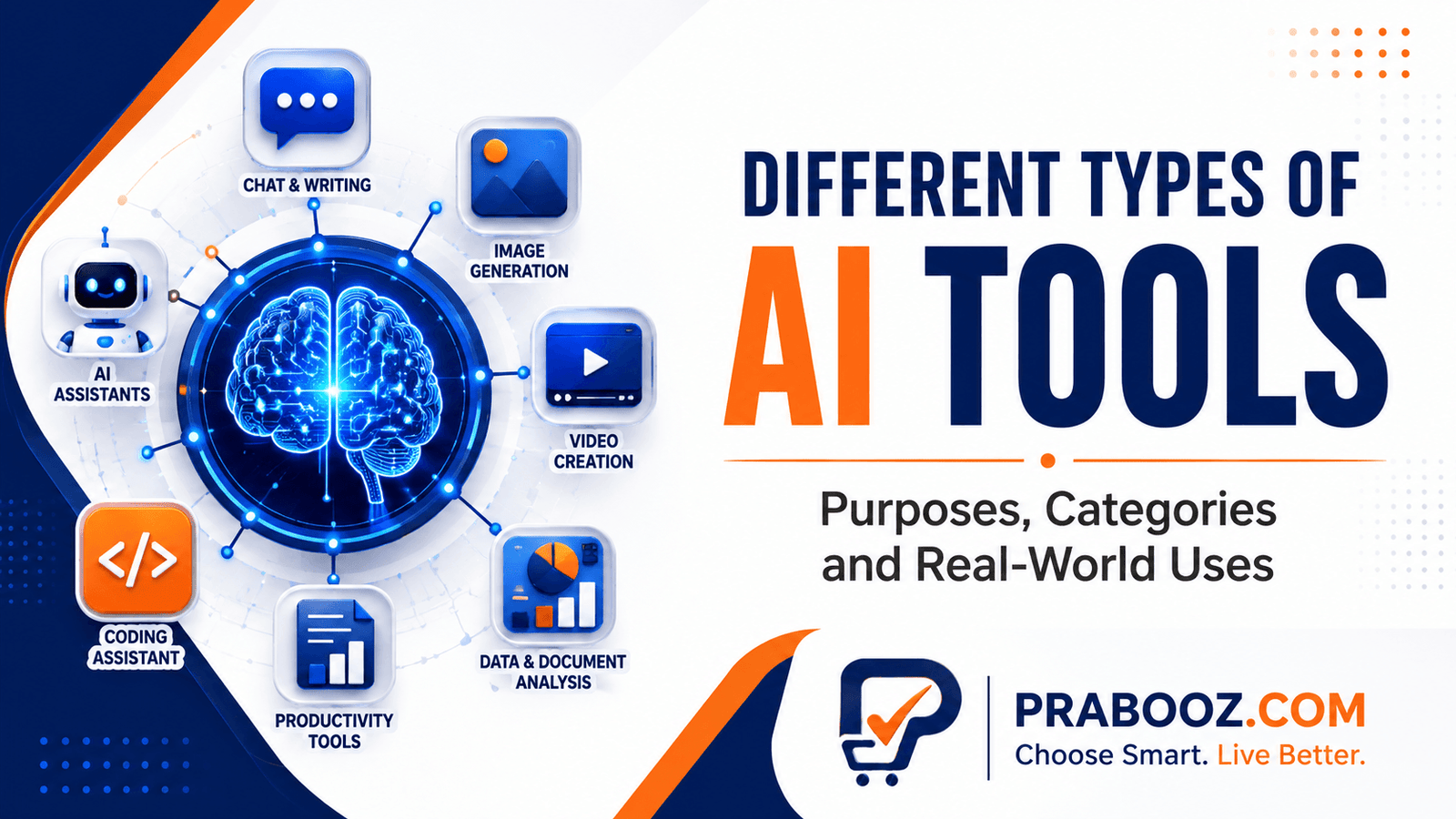
Artificial Intelligence is no longer a technology reserved for large corporations and tech experts. Today, AI helps people write content, create images, edit videos, build websites, analyze data, and even manage everyday tasks.
With thousands of new tools entering the market every year, choosing the right one can be confusing. Understanding the major AI tools types is the easiest way to identify which solutions can genuinely save you time, improve productivity, and help you achieve better results.
In this guide, we’ll explore the most important categories of AI tools, their primary purposes, and how to choose the right one for your needs.
At Prabooz, we believe in a simple principle:
Choose Smart. Live Better.
The goal is not to use more tools. The goal is to use the right tools.
What Are AI Tools?
AI tools are software applications powered by Artificial Intelligence (AI), Machine Learning (ML), and Natural Language Processing (NLP). If you’re new to AI, you can also read our guide What Is Artificial Intelligence (AI)?
In simple terms, an AI tool performs a task that normally requires human intelligence, but it does so faster, more accurately, or more efficiently.
For example:
- An AI writing tool can draft a blog post in seconds.
- An AI image generator can create professional graphics from a text prompt.
- An AI coding assistant can help build websites and applications faster.
- An AI productivity tool can automate repetitive tasks and save hours of work.
As AI technology continues to evolve, these tools are becoming essential for students, professionals, entrepreneurs, and businesses of all sizes.
Why Understanding AI Tool Categories Matters
Many people subscribe to multiple AI tools without understanding what each one is actually designed to do. This often leads to paying for duplicate features, choosing the wrong tool, and wasting money.
By understanding the different AI tools types, you can:
- Save money on software subscriptions
- Improve productivity
- Avoid tool overload
- Choose the best tool for each task
- Build a smarter digital workflow
Understanding AI categories helps you invest in the right tools instead of chasing every new trend.
Main Types of AI Tools and Their Purposes
he AI industry includes many specialized categories of tools. Each type is designed to solve different problems and improve specific tasks.
The table below provides a quick overview of the most popular AI tool categories and their primary uses.
| AI Tool Type | Primary Purpose / Best Use |
|---|---|
| Generative AI Tools | Create original content — text, images, audio, video, or code from prompts. Ideal for students, creators, and entrepreneurs. |
| Writing AI Tools | Draft, edit, and optimize written content for blogs, ads, and social media. Great for marketers and small businesses. |
| Image Generation Tools | Produce visuals, logos, and illustrations instantly from text descriptions. Perfect for designers and ecommerce brands. |
| Video AI Tools | Automate video creation and editing, add subtitles, and generate clips. Useful for YouTubers and educators. |
| Coding AI Tools | Write, debug, and explain code faster. Helps developers and startups accelerate projects. |
| Productivity AI Tools | Automate tasks, summarize meetings, and manage schedules. Ideal for professionals and remote teams. |
Let’s explore the major categories that are shaping the future of work and business.

1. Generative AI Tools
Generative AI is the foundation of many modern AI applications. These tools can create original content based on prompts provided by users.
Purpose: Generate text, images, audio, video, code, and other creative content.
Think of Generative AI as an all-in-one creative assistant. You can ask it to explain a complex topic, summarize a report, generate ideas, write content, or answer questions.
Best For
- Students
- Professionals
- Entrepreneurs
- Researchers
- Content creators
Popular Examples
- ChatGPT
- Google Gemini
- Claude
- Perplexity AI
If you’re new to AI, this category is usually the best place to start.
2. AI Writing Tools
AI writing tools are designed to help users create, improve, and optimize written content. They can generate blog posts, emails, product descriptions, social media captions, business reports, and marketing copy within minutes.
These tools don’t replace human creativity but act as intelligent assistants that speed up the writing process and help overcome writer’s block.
Purpose: Create and improve written content.
Best For
- Bloggers
- Students
- Digital marketers
- Businesses
- Copywriters
Popular Examples
- Jasper AI
- Writesonic
- Copy.ai
- Grammarly AI
If your work involves writing regularly, an AI writing tool can save significant time while maintaining quality.
3. AI Image Generation Tools
AI image generators create original images from simple text descriptions. Whether you need illustrations, marketing graphics, logos, product mockups, or social media visuals, these tools can produce professional-quality images in seconds.
Many designers now use AI image tools to generate ideas quickly before refining them further.
Purpose: Create digital artwork and visual content.
Best For
- Graphic designers
- Marketing teams
- Content creators
- Bloggers
- Business owners
Popular Examples
- Midjourney
- DALL·E
- Adobe Firefly
- Leonardo AI
AI image generation is transforming the creative industry by making high-quality design more accessible to everyone.
4. AI Video Creation Tools
Creating professional videos traditionally required cameras, editing software, voice recording, and hours of editing. AI video tools simplify this process by automatically generating videos from text, scripts, or presentations.
Some platforms even create realistic AI presenters that can speak naturally in multiple languages.
Purpose: Produce videos with minimal editing effort.
Best For
- YouTubers
- Educators
- Businesses
- Marketing agencies
- Social media creators
Popular Examples
- Synthesia
- Pictory
- Runway
- InVideo AI
These tools help create engaging video content without advanced editing skills.
5. AI Coding Assistants
AI coding assistants help developers write code faster, detect errors, explain programming concepts, and suggest better solutions.
Even beginners learning programming can use these tools to understand coding logic and improve their skills.
Purpose: Assist with software development and programming.
Best For
- Developers
- Software engineers
- Students
- Website creators
Popular Examples
- GitHub Copilot
- Amazon CodeWhisperer
- Cursor AI
- Replit AI
AI coding assistants significantly improve productivity while reducing repetitive programming tasks.
6. AI Productivity and Automation Tools
Many daily business tasks are repetitive, including scheduling meetings, organizing files, responding to emails, and transferring information between applications.
AI productivity tools automate these routine activities, allowing users to focus on more valuable work.
Purpose: Automate workflows and improve efficiency.
Best For
- Small businesses
- Entrepreneurs
- Office professionals
- Project managers
Popular Examples
- Notion AI
- Zapier AI
- Microsoft Copilot
- ClickUp AI
Automation not only saves time but also reduces human errors and improves consistency across business processes.
7. AI Search and Research Tools
Finding accurate information online can be time-consuming. AI search and research tools help users discover relevant information faster by summarizing content from multiple sources and providing direct answers instead of long lists of web pages.
These tools are especially useful for research, learning, and fact-checking.
Purpose: Find, summarize, and explain information quickly.
Best For
- Students
- Researchers
- Journalists
- Professionals
- Lifelong learners
Popular Examples
- Perplexity AI
- Google AI Mode
- ChatGPT Search
- You.com
These tools save time by reducing the need to visit multiple websites for basic research.
8. AI Data Analysis Tools
Businesses generate large amounts of data every day. AI data analysis tools help organize, analyze, and visualize this information, making it easier to identify trends and make informed decisions.
Instead of manually reviewing spreadsheets, AI can quickly process large datasets and present meaningful insights.
Purpose: Analyze data and support better decision-making.
Best For
- Business owners
- Financial analysts
- Marketing professionals
- Researchers
- Data teams
Popular Examples
- Microsoft Power BI with AI
- Tableau AI
- Julius AI
- ChatGPT Advanced Data Analysis
These tools help transform raw data into actionable insights.
How to Choose the Right AI Tool
With thousands of AI tools available, selecting the right one can feel overwhelming. Before subscribing to any platform, ask yourself a few simple questions:
- What problem am I trying to solve?
- Do I need text, images, videos, coding, or automation?
- Is there a free version available?
- Does it fit my budget?
- Will I use it regularly?
Choosing one tool that solves your primary need is often more valuable than paying for several tools with overlapping features.
The Future of AI Tools
Artificial Intelligence is evolving rapidly, and AI tools are becoming smarter, faster, and easier to use. Future AI systems will likely combine multiple capabilities—such as writing, image generation, video creation, coding, and data analysis—into a single platform.
As AI becomes a part of everyday life, learning how to use these tools effectively will become an increasingly valuable skill for students, professionals, entrepreneurs, and businesses.
The key is not to adopt every new AI tool but to understand which ones genuinely improve your work and simplify your daily tasks.
Final Thoughts
Artificial Intelligence is changing how we work, learn, create, and solve problems. From writing and designing to coding and automation, different types of AI tools are making advanced technology accessible to everyone.
By understanding the purpose of each AI tool category, you can make smarter decisions, improve productivity, and avoid spending money on tools you don’t need.
Whether you’re a student, professional, entrepreneur, or simply curious about AI, choosing the right tools can help you work more efficiently and stay prepared for the future.
At Prabooz, our mission is to help you discover practical technology that makes everyday life easier.
Choose Smart. Live Better.
Frequently Asked Questions (FAQ)
What are AI tools?
AI tools are software applications that use Artificial Intelligence to perform tasks such as writing, creating images, analyzing data, coding, automating workflows, and answering questions.
Which AI tool is best for beginners?
General-purpose AI assistants like ChatGPT, Google Gemini, and Claude are excellent starting points because they can help with a wide range of everyday tasks.
Are AI tools free to use?
Many AI tools offer free plans with limited features. Premium plans usually provide faster performance, advanced capabilities, and higher usage limits.
Can AI tools replace human jobs?
AI is more likely to assist people rather than completely replace them. It automates repetitive tasks, allowing humans to focus on creativity, critical thinking, and decision-making.
Which AI tool should I choose?
Choose a tool based on your needs. For example, use writing tools for content creation, image generators for graphics, coding assistants for programming, and automation tools for repetitive tasks.